Most businesses waste ad spend on platforms that miss their audience entirely. Broad-reach networks flood dashboards with empty impressions, leaving marketers with thin ROI and no clear path forward. FeedBuzzard Com changes that equation. It puts your campaigns inside a curated content environment where readers actively engage — and this guide shows you exactly how to make it work.
What Is FeedBuzzard Com and Why Advertisers Use It
FeedBuzzard Com is a digital publishing platform that connects brands with their relevant audience. For advertisers this platform is very important. You adds appears along the side with content. it increase reader engagement.
Next Question is who can take benefit from this platform. The answer is straightforward. Small business who have low budget and brands that have well budget both can take benefit. It keeps adding relevance.
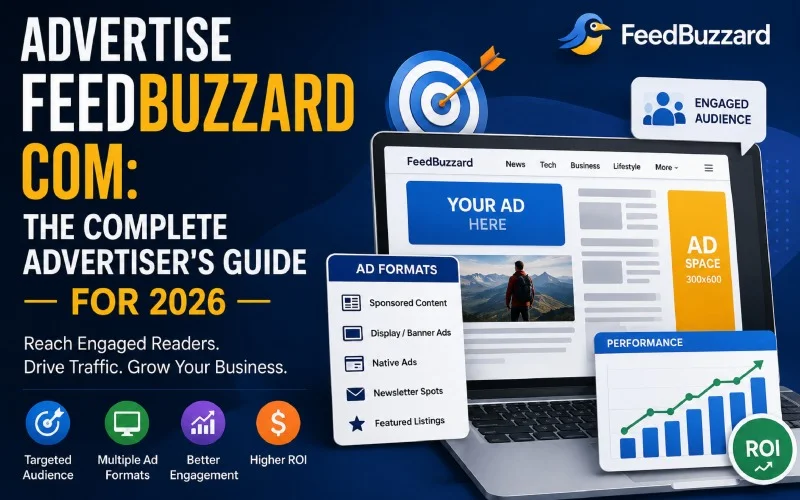
FeedBuzzard Ad Formats: What You Can Run
Choosing the right format determines whether a campaign builds awareness or drives direct conversions. FeedBuzzard supports five main advertising formats, each suited to different goals and budgets.
| Ad Format | Best Goal | Audience Fit | Cost Level | Engagement Potential |
| Sponsored Content | Brand awareness | Content readers | Medium | High |
| Display / Banner | Visibility & reach | Broad digital users | Low–Medium | Moderate |
| Native Ads | Trust-building | In-feed browsers | Medium | High |
| Newsletter Spots | Direct response | Subscriber base | Medium–High | Very High |
| Featured Listings | Product discovery | Purchase-intent users | Medium | High |
Sponsored Content
Sponsored articles are kept in editorial feed. They are clearly marked as sponsored.
sit inside the editorial feed and carry clear labeling. They read like standard platform content, which means engaged audiences spend more time with them. This format works best when your goal is trust-building or educating a warm audience about a product or service.
Display and Banner Ads
For your brand visual exposure banners option is also available. Banners generate reach at low cost. I user who have already seen your content gets second impression from banner and it improve sales.
Native Advertising
Native ads match the visual and editorial style of the surrounding content. Users see them as part of the reading experience rather than an interruption. This format consistently produces higher click-through rates than standard display across content-driven environments, which aligns directly with how the FeedBuzzard audience consumes information.
Newsletter Sponsorships
Newsletter placements is a best way to show you message to your audience. A newsletter that is well placed can outperform display because audience already trusts the sender.
Featured Listings
Featured placements highlight your product or service in a dedicated discovery section. Users visiting that section have explicit purchase or research intent, making this format ideal for product launches, seasonal promotions, and competitive positioning.
How to Set Up a Campaign on FeedBuzzard Com: Step-by-Step
Running a campaign through FeedBuzzard Com follows a clear sequence. Skipping steps — especially the verification and goal-setting stages — is the primary reason early campaigns fail to produce usable data.
| Step | Action | Why It Matters |
| 1 | Verify official FeedBuzzard Com advertise page | Avoids resellers and fake placements |
| 2 | Define campaign goal (awareness/leads/sales) | Determines format and budget allocation |
| 3 | Choose ad format (native, display, sponsored) | Aligns creative with audience intent |
| 4 | Set a small test budget first | Controls risk before scaling spend |
| 5 | Prepare a dedicated landing page | Higher conversion rate on click-through |
| 6 | Track CTR, impressions, conversions weekly | Enables data-driven optimization |
| 7 | A/B test ad creatives | Identifies top-performing message variants |
| 8 | Scale budget on proven ad sets | Maximizes ROI from validated campaigns |
Step 1: Verify the Official Advertise Page
Before any budget commitment, visit FeedBuzzard Com directly and locate the official advertise or contact page. Only use contact forms and email addresses published on the site itself. Third-party resellers exist for most content platforms, and their offers rarely match what the platform actually provides.
Step 2: Define Your Campaign Goal
Every format choice and budget decision flows from a single clear goal. FeedBuzzard campaigns typically target four outcomes: brand awareness, lead generation, direct sales, or app downloads. Mixing goals in a single campaign dilutes results. Pick one, build around it.
Step 3: Build a Landing Page Before You Buy
A weak landing page wastes strong ad performance. Your destination page needs a headline that matches the ad message, a clear call to action above the fold, and fast load times — more than 60% of all global web traffic arrives from mobile devices, according to Statista via HubSpot’s 2026 marketing statistics. A slow or misaligned page kills conversions before a visitor decides anything.
Step 4: Start With a Test Budget
Commit a modest initial budget — enough to gather statistically meaningful data across two or three ad creatives. Once one format and message combination demonstrates positive performance, scale that set rather than experimenting broadly. This method contains risk while building real campaign intelligence.
Targeting on FeedBuzzard: Reaching the Right Audience
Broad targeting wastes budget. FeedBuzzard’s targeting capabilities let advertisers filter audiences based on demographics, behavioral signals, interest clusters, and geographic location. The platform’s algorithm segments users by engagement patterns, not just stated preferences.
Behavioral segmentation is the more valuable of these tools. A user who consistently reads articles about software development carries different intent from one who reads personal finance content — even if both share similar demographics. Matching your ad format and message to the behavioral segment rather than just the demographic produces higher conversion rates.
Interest-cluster targeting also reduces wasted impressions. Rather than paying for eyeballs that have no relevance to your offer, you concentrate spend on the segment already aligned with your content category. For B2B advertisers in particular, this precision translates directly into lower cost per qualified lead.
FeedBuzzard Advertising vs. Other Digital Channels
No single platform works for every campaign. Understanding where FeedBuzzard sits relative to search ads, social platforms, and programmatic networks helps you decide how to allocate budget across a full media plan.
Search advertising captures users at high intent but competes on expensive keywords. Social platforms offer massive reach but face growing ad fatigue — users increasingly scroll past interruptive placements without registering the message. Programmatic networks reach large audiences cheaply but often place ads in low-trust environments that harm brand perception.
FeedBuzzard operates in a different space. Its editorial context produces what researchers call a “halo effect” — when ads appear beside content users trust, that trust transfers partially to the advertiser. Content-native placements generate higher brand recall than pre-roll or banner equivalents placed in non-editorial environments.
Industries That Perform Well on FeedBuzzard
Certain advertiser categories extract outsized value from content-first platforms. Understanding which industries perform best helps you gauge whether your offer fits the environment before spending.
E-commerce and retail brands benefit from native and display formats that place product imagery inside content feeds. Readers who encounter products within editorial context tend to engage more willingly than those hit by banner ads on utility sites.
Software and SaaS companies perform well through sponsored content. Long-form articles that educate prospects on a workflow problem and position the tool as the solution match how tech audiences prefer to evaluate purchases. This “educational sell” approach converts better in content environments than hard-sell banner placements.
Local service businesses, professional services firms, and B2B brands all find newsletter sponsorships particularly effective. The subscriber base of a niche publication represents a self-selected audience — people who have declared an interest by subscribing. That intent gap between a newsletter subscriber and a random display impression is substantial.
Measuring Campaign Performance: Metrics That Matter
Advertising on FeedBuzzard Com without tracking performance metrics is equivalent to driving without checking the fuel gauge. The platform provides campaign analytics, but you need to decide in advance which numbers you will act on.
Click-through rate measures whether the ad message resonates with the audience segment. A CTR significantly below platform benchmarks signals a mismatch between the creative and the reader’s intent — adjust the headline and image before scaling spend.
Conversion rate measures what happens after the click. If CTR is healthy but conversions are low, the problem sits on the landing page, not the ad. High impressions with low CTR indicate the ad format or placement needs adjustment, while low impressions suggest the targeting parameters are too narrow.
Return on ad spend remains the final arbiter of campaign health. Track total revenue attributed to the campaign divided by total ad cost. PPC advertising across digital channels yields an average 200% ROI when optimized, per Wordstream data cited in HubSpot’s 2026 marketing benchmarks. Use that as a baseline reference point to evaluate FeedBuzzard campaign performance objectively.
Five Mistakes Advertisers Make on Content Platforms — And How to Avoid Them
Most failed campaigns fail for the same five reasons. Identifying them before launch saves both budget and time.
- Generic creative not matched to editorial context. Ads that look and read like mass-market display placements produce weaker engagement in content environments. Write ad copy that reflects the language and tone of the surrounding editorial content.
- Skipping landing page optimization. Sending paid traffic to a homepage or a general product page dilutes the message. Each campaign needs a dedicated page that continues the conversation the ad started.
- Running too many formats simultaneously. Testing native, display, and sponsored content at once with a small budget produces inconclusive data on all three. Pick one format, validate it, then expand.
- Ignoring mobile performance. More than 60% of web traffic source is mobile. Adds and pages that are ot optimized for small screen may lose their value.
- Measuring vanity metrics instead of business outcomes.
Impressions and numbers look can impress you in reports but they can not tell you anything about revebue. Before setting your complain live add conversion tracking against your goals.
Budgeting for FeedBuzzard Advertising: A Practical Framework
Advertisers without a structured approach to budget allocation tend to overspend on underperforming placements and underspend on validated ones. The following framework applies regardless of total budget size.
Test phase (first 30 days): Allocate 20–30% of your monthly ad budget here. Run two or three creative variants per format. The goal is data, not conversions. Expect some waste — this is the cost of learning which message resonates.
Validation phase (days 31–60): Allocate 40–50% of budget to the one or two combinations that outperformed in testing. Track cost per conversion carefully. If numbers hold, you have a validated campaign.
Scale phase (day 61 onward): Move 70–80% of budget to validated ad sets. Keep a small test allocation running to discover new combinations as audience behavior shifts over time.
This three-phase structure prevents the common mistake of locking all spend into untested placements from day one and reduces the time needed to reach confident, scalable campaign performance.
Getting Started With FeedBuzzard Advertising
The path from first visit to live campaign on FeedBuzzard Com runs through three practical actions: verify the official advertise page on the site, define one specific campaign goal, and prepare a landing page before spending a dollar.
Advertisers who treat the first campaign as a data-collection exercise — rather than an immediate revenue event — consistently outperform those who scale prematurely. Start with a defined test budget, track the right metrics from day one, and let performance data drive every subsequent budget decision.
The combination of contextual ad placement, behavioral audience segmentation, and multiple format options makes FeedBuzzard Com a viable channel for brands that need measurable results from a content-aligned advertising environment.