
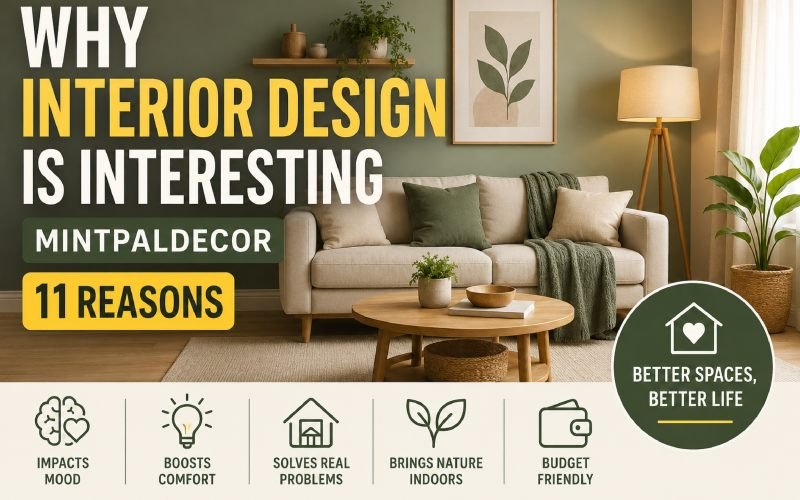
Have you ever walked into a room and immediately felt at ease? Maybe the light was soft. Maybe everything had a place. That feeling is not random — it is the result of intentional design.
That experience is exactly why why interior design is interesting mintpaldecor has become such a popular topic. Spaces shape your daily experience more than most people realize. And at MintPalDecor, we help everyday homeowners take control of that — without big budgets or fancy consultants.
Why Interior Design Is Interesting MintPalDecor: It Combines Creativity and Logic
First of all, interior design brings together two things most people think are opposites. On one side, you have art — color, texture, and visual beauty. On the other, you have function — how people move through a space, how much light reaches every corner, how storage fits into daily life.
Great design handles both at the same time. That balance is rare. And it is one of the biggest reasons this field attracts everyone from artists to engineers to everyday homeowners.
Expert Insight
In my experience, the best-designed rooms are rarely the most expensive. They are the rooms where every decision had a clear reason behind it — even the small ones. Does your home right now feel like it is actually working for you?
Your Room Affects Your Mood — And the Science Is Clear
The room you are sitting in is quietly affecting your stress levels and focus right now. Not might be. It is.
Research published in the International Journal of Environmental Research and Public Health confirmed that lighting, color, and room layout all trigger measurable changes in cortisol — the body’s main stress hormone. A 2025 review of 64 studies identified seven design factors that directly affect mental and physical health: lighting, air quality, layout, furniture, space size, barrier-free access, and relaxation design.
So your room is never neutral. It is either helping you or working against you.
Expert Insight
86% homeowners almost underestimate the power of lighting. By changing overhead bulb to a warmer 2700K your room atmosphere will change. It will give a look more that a look appearing after a coat of paint. How does your home make you feel the moment you walk through the door?
Good Design Does Not Require a Big Budget
Here is something most design content never says: some of the biggest transformations cost nothing at all.
One client had a perfectly fine living room — decent sofa, clean walls. But it felt empty and cold. We pulled the sofa away from the wall, added a throw she already owned, and moved one lamp to a dark corner. Total cost: zero dollars. The room suddenly felt warm and lived-in.
Money is not the point. Intention is. Before buying anything new, try rearranging what you already have.
Pro Tip
At MintPalDecor, our beginner guides focus on low-cost, high-impact changes — because that is what actually works for most people. Start with what you already own.
Color and Lighting: The Two Fastest Fixes in Any Room
Quick question: how does a bright red room make you feel compared to a soft sage green one? Your body reacted differently to each, did it not? That is color psychology — and interior designers use it on purpose.
- Blue tones lower anxiety and heart rate
- Warm neutrals create comfort and welcome
- Terracotta and rust encourage energy and conversation
- Deep navy or charcoal add drama and visual depth
Lighting works the same way. Most homes rely on one harsh overhead source. Layered lighting — ceiling light plus a floor lamp plus a table lamp — creates depth that no single fixture can match. And switching to bulbs in the 2700K to 3000K range costs about $8 and takes three minutes.
Want to fix a dull room fast? Start with color and lighting before you buy anything else.
Interior Design Solves Real Everyday Problems
Great design is problem-solving. A family that is growing need more space. Similarly a small apartment need furniture that can be used for multiple purposes at a time. An office at home need lightening pattern that reduces eye strain.
81% people think that they need more space. Usually 90% problems can be solved by better organization and buy using smart furniture. Many problems can be solved without spending a cent.
Pro Tip
Use vertical wall space instead of floor space. Place a mirror across from a window to double the natural light. Choose a bed or sofa with built-in storage. These small moves solve real problems.
Interior Design Is a $145 Billion Industry Growing Every Year
Some people still think of interior design as a hobby. The numbers say otherwise.
According to Grand View Research, the global market was worth $145.3 billion in 2024 and is projected to reach $222.2 billion by 2032 — a 5.45% annual growth rate. Remodeling is now the fastest-growing segment, outpacing new construction. People are investing in the spaces they already have.
Quick Look: Poor Design vs. Better Design
| Element | Poor Design | Better Design |
| Lighting | Single harsh overhead | Layered warm sources |
| Storage | Cluttered surfaces | Hidden, organized storage |
| Furniture layout | All pushed against walls | Pulled in, creating zones |
| Natural elements | None — all synthetic | Plants, wood, or linen |
Source: Grand View Research / Credence Research, 2024
Bringing Nature Indoors Makes You Healthier — Not Just Happier
Plants, wood, and natural light feel good because of biology, not preference. Biologist E.O. Wilson’s biophilia hypothesis explains that humans are hardwired to connect with nature. It is proven by 2026 research that biophilic design in hospitals reduces patient stress by 80-90% You do not need a big budget for this. One plant on a desk, a timber side table, linen curtains that filter morning light softly — these small moves create real physiological benefits every single day.
Interior Design Is a Skill Anyone Can Build — Starting Today
You do not need a degree to develop a good eye for design. You build it through observation. Every room you walk into is a free lesson.
Ask yourself: why does this coffee shop feel relaxing? Why does that waiting room feel tense? What is the lighting doing? Over time, those questions build a genuine design instinct — one that you start applying automatically at home.
That ongoing growth is a big part of why interior design is interesting mintpaldecor readers return to this subject again and again.
Pro Tip
Try this for one week: Every time when you visit new place, identify one thing that is designed perfectly. Also note another thing that can be improved and think how you can improve it. After one week you will see every room differently.
Final Thoughts
So, why is interior design so fascinating? Because it improves your actual daily life — every morning, every evening, every time you sit in a room that finally feels right. Now you understand why interior design is interesting mintpaldecor keeps resonating with homeowners across every budget. It is not about decorating rooms. It is about improving everyday life through thoughtful choices. Start with one small change today. Move a lamp. Add a plant. Rearrange one shelf. You might be surprised by how much one intentional decision changes everything.