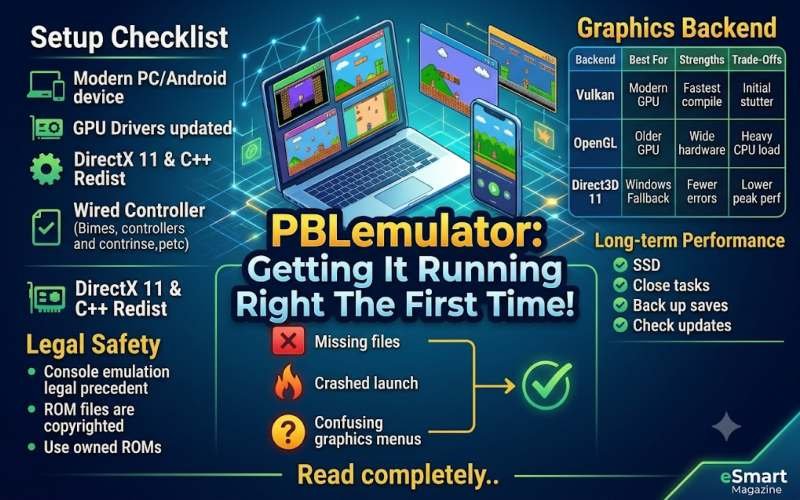
Getting PBLemulator running for the first time can feel confusing. Many baggers stop working before they load heir first game. Reasons may be different like:
- Missing files,
- Crashed launches, and
- Confusing graphics menus
70-80% guides does not tells that these problems orginate due to improper steps not technical issues. This Guide will explain everything from installation to configuration. So read it completely..
What Is PBLemulator?
PBLemulator functions as an emulation tool. It is used to play classic games to modern Computers and Android devices. It makes the modern hardware compatible with older gaming systems like RetroArch or Dolphin. The project connects closely with PlugboxLinux, a lightweight Linux setup built around scriptable emulator management rather than a traditional graphical interface.
Is PBLemulator Safe and Legal to Use?
Console emulation has a long legal history in the United States, and courts have repeatedly sided with developers who build emulators through clean reverse engineering rather than by copying a console’s proprietary code.
According to Managing IP’s coverage of the Nintendo v. Yuzu case, Nintendo of America sued Tropic Haze, the maker of the Yuzu emulator, and the case ended in a settlement requiring the company to pay 2.4 million dollars and permanently stop developing the software. That case did not argue that emulation itself was illegal. It centered on Yuzu’s ability to bypass Switch encryption, which is a narrower legal issue than running an emulator on its own.
A separate Lexology summary of the settlement notes that emulator software itself has been protected by legal precedent for decades, dating back to a 1999 case in which Sony sued the maker of an early PlayStation emulator and lost. That precedent still shapes how courts view emulators today.
The real legal risk sits with ROM files, the actual game data, rather than the emulator software. ROM files remain copyrighted regardless of how someone obtains them, and owning a physical copy of a game does not create an automatic right to download a digital copy from the internet. Anyone setting up PBLemulator should load only ROM files created from games they personally own or files obtained through clearly authorized channels.
What Do You Need Before Installing PBLemulator?
A short checklist before starting saves time later:
- A modern PC or Android device with an updated GPU driver
- DirectX 11 Runtime and the Visual C++ Redistributable package, for Windows installs
- A dedicated folder with separate subfolders for BIOS files, ROM files, and configuration files
- A wired controller with XInput or SDL2 support, if console-style input is preferred
- Legally owned ROM files, since the emulator does not include games
How Do You Install and Configure PBLemulator?
Follow these steps in order to avoid the most common setup mistakes:
- Download the installer only from the official source, and avoid third-party mirror sites.
- Check the file size and digital signature before running it. A file that is unusually small is often a sign of a fake download.
- Run the installer and choose a dedicated folder, separate from other programs, as the install location.
- Create BIOS, ROM, and configuration subfolders so the emulator can locate files without errors.
- Launch the emulator once, and let the automatic hardware detection scan finish before changing any settings.
- Set graphics, audio, and control options during first launch rather than skipping straight to a game.
Which Graphics Backend Should You Choose?
PBLemulator supports more than one rendering backend, and the right choice depends on the hardware running it.
| Graphics Backend | Best For | Strengths | Trade-Offs |
| Vulkan | Modern GPUs (2018 or newer) | Fastest shader compilation, strong frame pacing, supports upscaling | Shader cache building can cause brief stuttering on first launch |
| OpenGL | Older or integrated GPUs | Wide hardware compatibility, stable on aging systems | Places heavier load on single-core CPU performance |
| Direct3D 11 | Windows systems with unstable Vulkan drivers | Balanced fallback option, fewer shader compilation errors | Slightly lower peak performance than Vulkan |
Most users on a modern GPU should start with Vulkan and only switch to OpenGL or Direct3D 11 if they run into driver stability issues. Readers who want more retro gaming and emulator coverage can find additional setup guides on the gaming section of eSmart Magazine, which regularly reviews new gaming tools and technology.
How Can You Fix Common Setup Problems?
- Emulator will not launch: First of all try this one. Install DirectX 11 Runtime and the Visual C++ Redistributable, then restart the system.
- Controller not detected: reconnect the controller before launching the emulator, and confirm it uses XInput or SDL2 mapping.
- Android installation blocked: enable unknown sources in the device settings before installing the APK file.
- Games load but crash quickly: this maybe due to incorrect ROM file match or its format. Check and clear this point.
Best Tips for Long-Term Performance?
- Use SSD (Solid State Drive) instead of traditional hard to reduce loading times.
- Before using this close all tasks that are running at background. It free up space on CPU and memory resources.
- Back up save files and configuration folders regularly, since a reinstall can otherwise erase progress.
- Check for emulator and GPU driver updates every few months to avoid compatibility issues with newer game files.